

How to tell hornets and wasps apart
Although hornets and wasps belong to the same family, Vespidae, they have differences. Recognizing these distinctions is essential for pest management and personal safety.
Hornets and wasps serve distinct roles in ecosystems and can pose challenges when encountered in human environments. Misconceptions and confusion often arise when distinguishing wasps from hornets due to their similar appearances and shared family classification.
What is the difference between a wasp and a hornet? Which is worse, a wasp sting or a hornet sting? Are wasps or hornets more aggressive? We'll answer these questions and more as we explore these stinging insects and their characteristics.
Identifying hornets vs. wasps
Understanding the differences between hornets vs. wasps is crucial for effective pest management.
Characteristics of wasps
Wasps are characterized by their slender bodies and distinctive black and yellow stripes and typically have a smooth, shiny appearance.
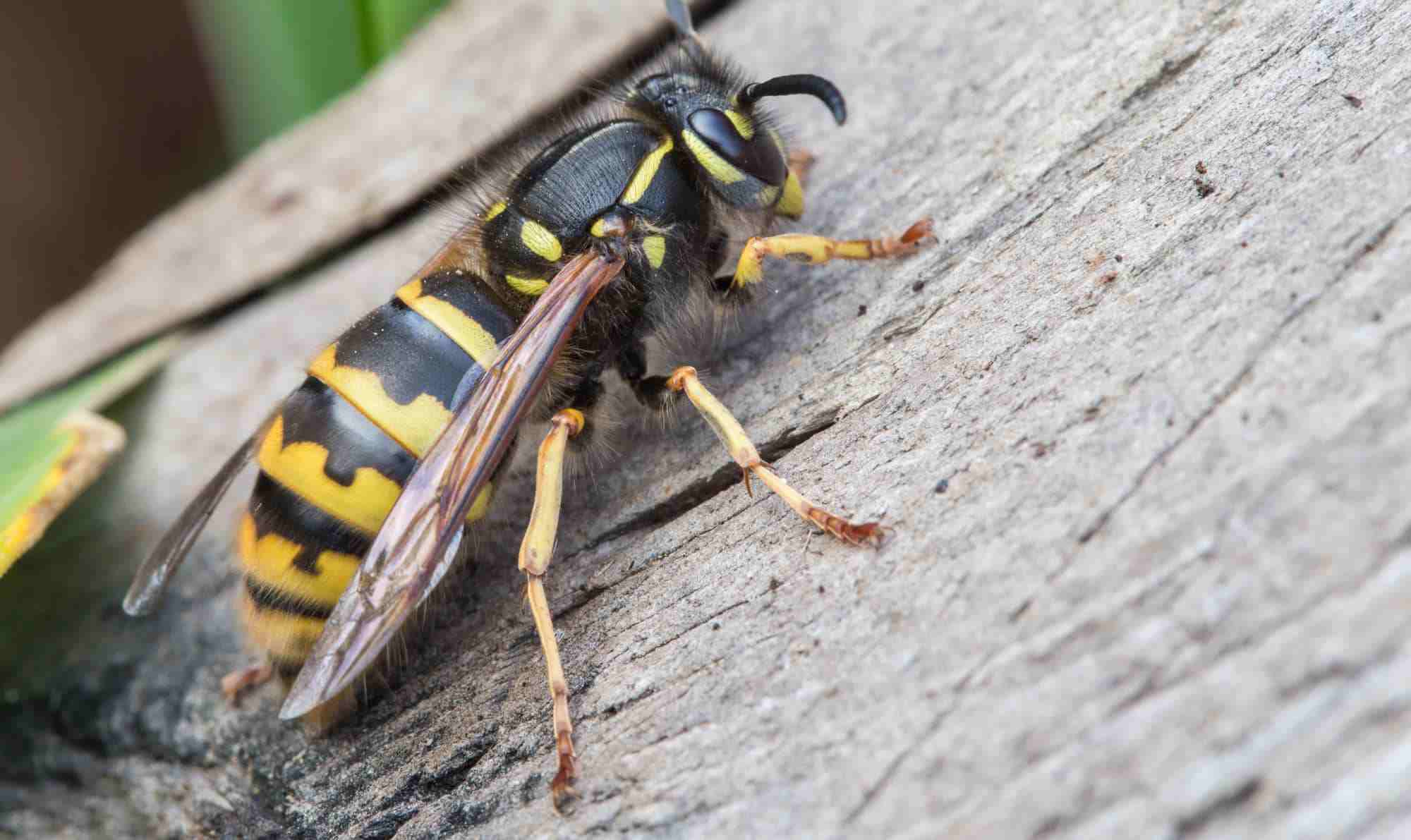
Wasps are scavengers and predators, feeding on other insects and sugary substances like nectar and fruit juices. Some species are social, living in colonies with a distinct hierarchy, while others are solitary.
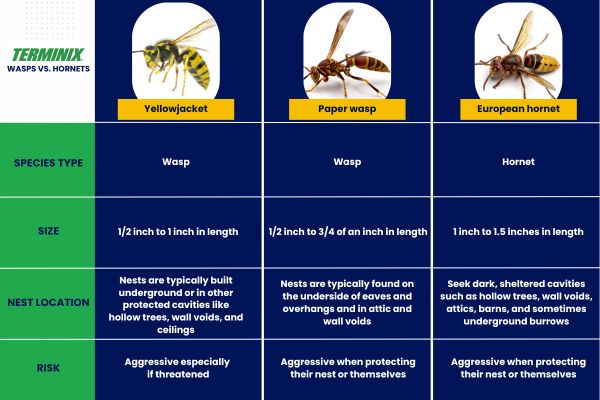
Common wasp species include yellow jackets and paper wasps. Yellow jackets are social and live in large colonies. They are among the most aggressive and commonly encountered wasps. They build paper nests in underground burrows, wall voids, or aerial locations.
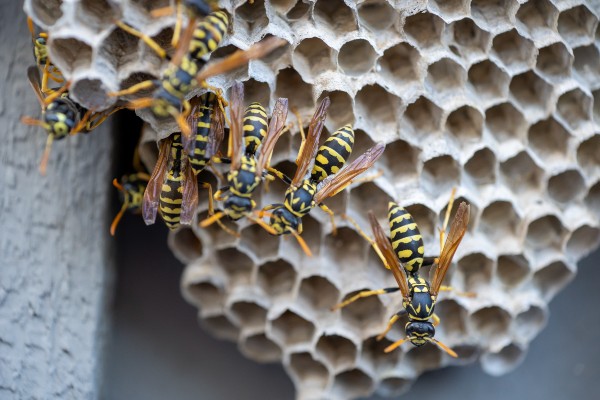
Paper wasps are reddish‐brown or dark red. They construct paper‐like nests from plant fibers mixed with saliva. They are typically less aggressive than yellowjackets but can deliver painful stings if provoked.
Characteristics of hornets
Hornets, on average, range from 0.75” to 1.5” in length and have distinctive black and yellow markings on their bodies. Their exact coloration can vary by species. When comparing hornets vs wasps, hornets have thicker and more elongated bodies and more prominent heads than wasps.
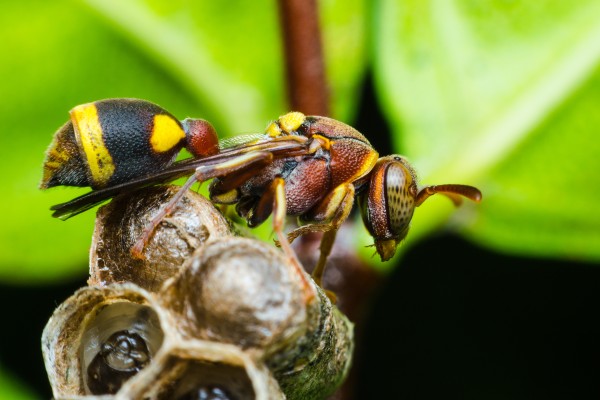
Hornets are a subset of wasps and will aggressively defend their nests. They have been known to sting humans and animals even when no threat is present. Additionally, they are social insects. They live in colonies with a well‐defined hierarchy, including a queen, workers, and drones.
European hornets are one of the most common hornets in North America. They resemble yellowjackets and typically nest in the ground or hollow trees.
Hornets and wasps vs. bees
Hornets, wasps, and bees are all members of the order Hymenoptera, but they belong to different families within that order. Bees play a significant role in pollination and honey production, with many species living in colonies and constructing hives from wax.
Bees are generally more robust and have a fuzzy appearance due to the dense hair covering their bodies. Hornets and wasps are usually more aggressive than bees and have sleeker bodies with narrow waists.
Nesting habits
Understanding the nesting habits, preferred locations, and structures of wasps vs. hornets is essential for identifying and managing infestations.
Wasp nesting habits
Wasps have diverse nesting habits. Some are solitary, and others have social colonies with queens, workers, and drones. Nests can be found in various locations like underground burrows, trees, and buildings.
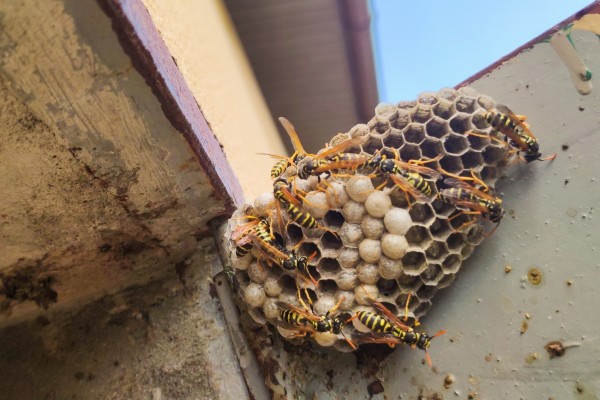
Their nests are constructed from wood fibers mixed with saliva. The inside of the nest has a honeycomb pattern. The appearance can vary, but typically, ground‐nesting wasps build simple burrows in the soil, while social wasps construct more elaborate paper nests. Paper nests can range from small, golf ball‐sized nests to large, basketball‐sized ones.
Hornet nesting habits
Hornets exhibit similar nesting habits. They can be social or solitary, but most hornet species are social and build communal nests. Initiated by a single queen, colonies construct communal nests in sheltered locations like trees, attics, under eaves, or in shrubs.
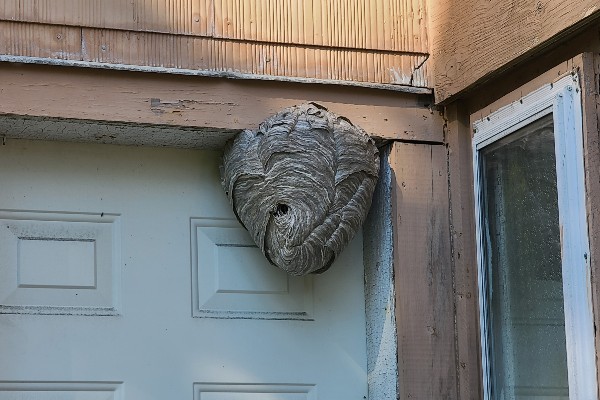
Their nests are made from wood fibers mixed with saliva and shaped like a football or teardrop. They're typically enclosed in a protective outer layer.
Life cycles
Wasps and hornets undergo complete metamorphosis, beginning as eggs and progressing through larval, pupal, and adult stages. A fertilized queen emerges in spring, establishes a colony, and lays eggs. Larvae, fed by the queen or workers, develop into adult workers that forage and maintain the nest. As the season ends, new queens and males mate, and fertilized queens seek shelter for overwintering and starting new cycles.Behaviors
There are many behavioral differences between hornets and wasps, such as their social structures, aggression levels, and nesting preferences.
Are wasps or hornets more aggressive?
Hornets are highly territorial and will defend their nests if they feel threatened. They can sting multiple times, and their venom is more potent than other wasp species. Wasps do not have the same aggressive tendencies as hornets. Many wasp species are relatively harmless to humans and will only sting if provoked.
Hornet vs. wasp diet
Hornets are omnivores and feed on various insects, nectar, and tree sap. They are fierce predators and can take down prey larger than themselves. Wasps are also omnivores and feed on similar insects and carbohydrates.
Wasps vs hornets through the seasons
Wasps and hornets respond similarly to each season. During the spring, fertilized queens emerge to establish new colonies by laying eggs. In the summer, colonies reach peak activity, with workers foraging and nests expanding rapidly. Colonies decline as temperatures cool in the fall, and new queens prepare to overwinter. Most colonies have died off by winter except for fertilized queens, which hibernate until the following spring.
Wasp vs hornet stings
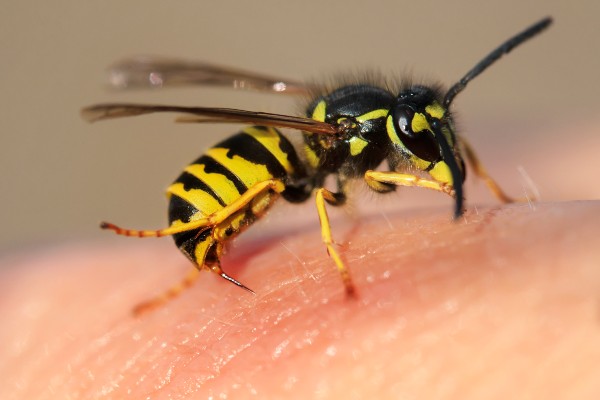
The severity of a sting from a wasp vs. hornet varies and depends on factors such as an individual's sensitivity and the location of the sting. Hornet venom is potent and, once injected into the skin, can cause an immediate reaction.
The venom composition may differ slightly between species, which could influence the intensity of the pain. Generally, both stings cause discomfort and localized swelling, with the potential for severe reactions in allergic individuals.
Ecological role and benefits
Wasps and hornets serve important roles as predators in ecosystems. Hornets play a vital role in maintaining a balanced ecosystem by controlling insect populations like caterpillars, flies, spiders, and other small insects. Wasps help to reduce plant‐eating pests like aphids, flies, grasshoppers, and caterpillars. Some wasp species are pollinators and help maintain plant populations.
Wasp and hornet prevention and control
Hornets and wasps play an essential role in maintaining a balanced ecosystem but can become a nuisance when populations become too large. A professional pest control company should help manage the populations and prevent infestations in these cases.
To peacefully coexist with wasps and hornets until professional assistance arrives, avoid disturbing their nests or swatting at them, and keep food and garbage containers tightly sealed. Attempting to remove the nest on your can be dangerous and result in being stung multiple times. Our technicians have the expertise and equipment to remove the nest and the insects safely. Contact us today to learn more about our stinging pest control services.