

Spider Web Information: Types of Webs and How to Get Rid of Them
Spider webs are intricate structures built by spiders using spider silk. These webs serve various purposes, including capturing prey, providing a protective space, and sometimes even being a means of communication among spiders. Spider webs vary in shape, size, and complexity, often reflecting each spider species. Finding cobwebs in your home may indicate there are spiders present, but that doesn't necessarily mean there is an infestation. Spiders are natural inhabitants of the environment, and spotting a web, especially in less-disturbed areas of a home or garden, is quite common. Learn how to identify each type of spider web and what to do if you spot one in your home.
Why spiders spin their webs
Spiders spin their webs for many reasons. These intricate structures serve as both shelter and a means to capture prey, allowing spiders to secure themselves both a safe haven and an effective trap for catching their next meal. However, not all spiders make webs. The diversity among spider species means that some have evolved different strategies for survival and hunting. Despite these differences, spider webs play a crucial role in the ecosystem as they can help control insect populations and serve as a natural pest control mechanism. The presence of spider webs can actually indicate a healthy, balanced ecosystem.

The engineering behind spider webs
The structure of a spider's web is meticulously crafted to optimize both resilience and efficiency in prey capture. The lifecycle of a spider web can vary among species. Many spiders create a new web each day, but some webs are continuously built upon or repaired over time. At dusk or dawn, they consume the old web, recycle the spider silk proteins, and then spin a fresh web. This behavior ensures that the web's sticky surfaces remain effective for capturing prey.
Silk production
Spider silk production is a unique process that results in various types of spider silk, including dragline silk, capture spiral silk, and structural silk. These silks are produced in the spider's silk glands, and the type of silk produced is determined by the specific gland it comes from. Dragline silk, known for its strength and elasticity, is used by spiders as a lifeline for hanging and swift movements. Capture spiral silk, which is more stretchy and sticky, is designed for trapping prey in webs. Structural silk serves as the foundation for the construction of webs, offering durability and support.
The different types of spider webs
There are many different types of spider webs, each with their own unique characteristics and purpose. Let’s take a look at some of the most common spider webs:
Orb webs
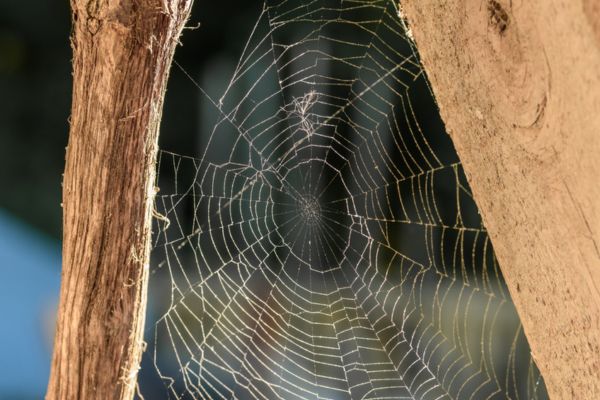
Orb webs typically feature a spiral of sticky capture silk, supported by non-sticky radial threads that anchor the web and provide its structural foundation. The radial and spiral arrangements help distribute tension evenly, allowing the web to withstand the impact of prey as well as environmental factors like wind and rain. The size and spacing of the silk threads can vary greatly, depending on the size and type of prey the spider intends to capture. Some species construct large, conspicuous spider webs in open areas to catch flying insects, while others build smaller, more discreet webs under leaves or between branches.

Cobwebs
Cobwebs are often messy, irregular spider webs found in corners, under furniture, or in other less-disturbed areas. Unlike the more structured orb webs or funnel webs, cobwebs lack a defined pattern and appear as a tangled mess, which effectively captures wandering prey. The support structure of cobwebs is typically anchored to multiple points, allowing these webs to cover larger areas with seemingly random threads.

Funnel webs
Funnel webs are characterized by their distinctive funnel-shaped retreats. These spider funnel webs are typically flat and expansive, with a dense, silk-lined funnel where the spider hides. The open, sheet-like area of the spider funnel web is designed to catch prey, which, upon touching the web, is quickly ambushed by the spider emerging from the funnel. The structure and placement of the web are highly influenced by the habitat—ranging from ground level in grassy areas to shrubs and trees.

Sheet webs
Sheet webs feature a distinctive horizontal or slightly inclined webbing that resembles a sheet. These webs may be suspended between branches or grasses, utilizing their broad, sheet-like structure to capture a variety of insects. The underlying support structure of a sheet web often includes a complex network of threads that anchor the sheet to nearby objects, providing stability and flexibility to the spider web.

Triangle spider webs
Triangle spider webs, crafted by the aptly named triangle spiders, are primarily recognized for their triangular shape. This three-point structure is a highly effective mechanism for prey capture. The support structure typically involves a main anchor thread from which the rest of the web is suspended, creating a tension-based system that can be quickly adjusted by the spider to capture prey. Some triangle spiders may opt for larger or more densely woven webs to capture different or greater quantities of insects, while others might adjust the placement of their webs based on the availability of structural support in their environment.

What you can do about spider webs in your home
Finding spider webs in your home can be unsightly, but it can also indicate a more serious problem. Typically spider webs within your home can be managed with regular cleaning, like dusting and vacuuming. However, if you find an increasing number of webs, especially in living spaces, or if you suspect you have a more dangerous species, such as black widows or brown recluses, in your home, it's time to seek professional help. At Terminix, our experts are trained to safely treat and remove these insects from your home.
Contact the Terminix spider control experts today.