

Joro spiders (Trichonephila Clavata)
Contributed by: Timothy Best, MSPH, BCE, Technical Manager, Terminix
Updated on: October 7, 2024
Some of the biggest news on the “web" these days is being made by a spider. If you're reading this, it's likely that you've already started your own research on the invasive Joro spider, Trichonephila clavata. Joro spiders are an invasive species of the Golden orb weaver spider that were first discovered in Northern Georgia in 2014.
This spider has been making the news in the pest industry as a result of published research that suggests that due to the invasive spider's physiology, it has the potential to increase its range by surviving in cooler climates.
Worried about spiders invading your home? Schedule an inspection with our experts and get peace of mind with our effective spider control services. Let's separate fact from fiction and answer some of the most commonly asked questions about this spider, including:
- What does a Joro spider look like?
- Joro spider origins and habitats and U.S locations
- How are Joro spiders moving about the United States?
- Are Joro spiders dangerous?
- Joro spider lifespan
- What do Joro spiders eat?
- What eats the Joro spider?
- Joro spider web strength and applications
- Is control of the Joro spider necessary?
- Joro spider prevention tips
What does a Joro spider look like?
The key characteristics of a Joro spider are:
- Extremely long legs (legs can be four times as long as the body)
- Striped legs (often yellow and black)
- Bright colors (red, yellow, brown, blue, and black)
- Usually appear in fall months (September and October)
- Weave distinct three-layered, orb-shaped, gold-tinted webs
The adult female Joro spider is large and brilliantly colored with bright yellow and grey-blue bands and patterns on both its upper and lower abdomen. The cephalothorax is covered with silvery and golden hairs, and the legs are black with yellow bands.
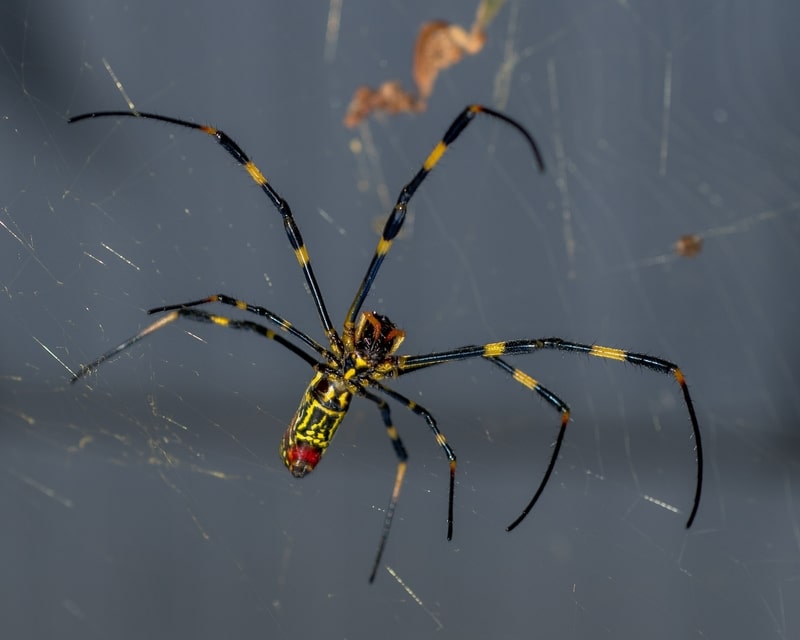
Maybe the most stunning feature of this spider is its size. Female body length can measure up to one inch, with a leg span of up to four inches. To put that into perspective, the average size of a human palm is three to three and a half inches.
Male Joro spiders are much smaller and less vibrantly colored than the females. Their body length is typically 0.3 inches, and they have more dark brown colors.
Joro spider origins, habitats, and U.S. locations
Named after a Japanese spider demon (Jorogumo), Joro spiders hail from Southeast Asia. They are common in China, Japan, Korea, Taiwan, and Vietnam. In the early 2010s, the spider arrived in Georgia, likely via shipping containers imported into the United States. Since then, these arachnids have been spotted in various points across the southeast.
While Joro spiders prefer warmth and humidity, they can survive in virtually any weather. Recent research indicates they may be able to survive in much colder temperatures than initially known. Their resistance to the cold could cause them to spread to Northern states in the future.
Since their discovery in the U.S., the Joro spider has been found in Alabama, Georgia, South Carolina, North Carolina, and Tennessee. There have also been unconfirmed reports of this spider in Maryland, Oklahoma, and West Virginia. Scientists at the University of Georgia announced that the Joro spider will spread up and down the East Coast over the next few years.
It seems like these spiders are here to stay, but they aren’t searching for homes to live in. They prefer to build their webs on the outside of a house or other structure.

Are Joro spiders a threat to native ecology?
As with most invasive, non-native species, there is a lot we don't yet know or understand about the Joro spider. They might impact native ecology by competing with native spiders for food. This spider species could also help control invasive species like stink bugs and spotted lanternflies. They may displace native spiders, but some entomologists believe their ecological impact will be mild.
How are Joro spiders moving about the United States?
Joro spiders use two primary methods to move around. One method is by hitchhiking with humans – winding up in cargo shipped around the world and finding their way to new lands. The other method is through a process known as ballooning.
Ballooning is when newly hatched spiderlings climb as high as they can, stand on raised legs, and then release several threads of silk from their spinnerets. These thin silk threads act as a parachute, allowing the spiderlings to travel with the wind as they are swept up in air currents.
Depending on species and other environmental factors (like wind speeds), ballooning may carry spiderlings from tens to hundreds of miles away. Current estimates only have the Joro spider being moved into bordering states no more than 80 miles away from where it was initially found.

Are Joro spiders dangerous?
Joro spiders are venomous but do not pose a danger to humans or pets as they are typically reluctant to bite, and their bites and venom are very weak. Joro spiders will often only attempt to bite if they are being constrained. If this spider bites you or your pet, an allergic reaction is possible, but no instances have been reported.
Joro spider lifespan
The Joro spider's lifespan is typically around a year but can vary based on environmental conditions. An adult female spider can lay between 400 and 1,500 eggs in a year. They hatch in the spring, mature over the summer, and often die off by late fall or early winter. In some cases, particularly in warmer climates, they may survive longer.
What do Joro spiders eat?
A Joro spider's diet includes a variety of insects, such as mosquitoes, stink bugs, yellow jackets, beetles, bees, and biting flies. They are passive hunters and wait until a small insect gets tangled in their web. Once inside, the spider wraps the prey in silk and uses venom to subdue it.

What eats the Joro spider?
Joro spiders share many of the same predators as other spider species. Some of their predators include birds, lizards, frogs, bats, and certain wasp species, such as Mud daubers.
Joro spider web strength and applications
Joro spiders weave strong, three-layered webs that can be up to 10 feet wide. Researchers from China's Southwest University discovered how Joro spiders create strong dragline web silk, which could inspire better synthetic silks. This new, high-tensile fiber can have many uses. For example, it's great for making stockings, socks, fishing lines, and tennis racket netting.

Is control of the Joro spider necessary?
Due to their minimal medical and economic impact, control measures for Joro spiders aren't necessary or established. As a nuisance pest, they don't require pesticide applications. Joro spiders and their webs can be removed with a broom or cobweb brush if found on or around a structure.
Joro spider prevention tips
While Joro spiders aren't dangerous to humans, they can be a nuisance. If you want to prevent these pests from settling in your yard or around the house, consider these prevention tips:
- Watch your landscaping. Rich vegetation against your house could cause Joro spiders to settle there.
- Don't leave outdoor lights on. Bright lights can attract insects, which in turn can attract Joro spiders that will eat them.
- Eliminate hiding places. Joro spiders prefer lush vegetation, leaf piles, and woodpiles.
- Clean your home regularly to check for spider webs and remove them.
- Seal cracks and holes around windows and doors to prevent spiders from entering.
Implementing these strategies can help keep your home and yard free of Joro spiders, creating a more comfortable environment.