Rats Facts, Information, and Pictures
Scroll down to learn more about what rats look like, their behavior, rat control and more.
Rats, often seen as pests, are intelligent and adaptable rodents that have coexisted with humans for centuries. Understanding these unwelcome intruders, their behavior and habits, and the health risks they pose are beneficial for effective prevention and control. Effective rodent control can involve identifying and eliminating entry points, removing food sources, and using traps or baits to help reduce populations.
What do rats look like?
If you're trying to identify a rodent in your home, remember that rats are much larger than mice. Rats typically measure nine to eleven inches in body length, with their tails adding another seven to nine inches. Their heads are proportionally larger compared to their bodies.
Unlike mice, which have a light coating of fur on their tails, rat tails are hairless and scaly. Depending on the species, rats can appear in various colors, including brown, black, gray, or even white. It is not uncommon to see white rats, as this could indicate an escaped pet.

What are the common types of rats in the U.S.?
Common types of rats in the US include:
- Norway rats are large with robust bodies, blunt noses, and short ears. They are typically brown or gray with a lighter underside. These rats can be found in urban and suburban areas throughout the U.S. and tend to enter homes in the fall when outdoor food and water sources become scarce. They can nest in basements and ground floors, although they can also inhabit attics and roofs.
- Roof rats have slender bodies, pointed noses, large ears, and scaly tails. They are usually black or dark brown, with white, gray, or black undersides. In the U.S., they’re typically found in coastal and southern regions but are rapidly spreading to other parts. They’re excellent climbers and can inhabit attics, roofs, or upper levels of buildings.
- Cotton rats are medium-sized rodents with rough hair, large ears, and short tails. These rats are smaller than roof rats. They are rodent pests of crops and can be associated with structures during harvests. Different subspecies live in various environments, including marshes. Similar to pack rats, however, harborages are not as complex. Heavy ground cover that is generally associated with ditch banks, meadows, wet areas along the edges of marshes, fence line vegetation, cactus patches, and other dense vegetation can serve as a nesting area.
- Pack rats have large black eyes, long whiskers, and their tails are covered with short hairs. They can be gray or reddish brown with a light underside. They’re known to collect various objects in homes and other structures. They’re typically found in the southwestern U.S. Pack rats build huge, intricate nests from twigs, debris, and other items they collect. In some cases, these nests can be as wide and as deep as eight feet.
How long do rats live?
Rats typically live for about one to two years in the wild. The lifecycle of a rat is as follows:
- Birth and infancy: Rats are born after a gestation period of about 21 to 23 days. Newborns are blind, hairless, and completely dependent on their mothers.
- Juveniles: It can take five to eight weeks before they are weaned and become fully independent.
- Adulthood: Rats reach sexual maturity when they are eight to 12 weeks old. Female rats can become pregnant immediately after giving birth, leading to rapid population growth.
Understanding rat behavior
Did you know that rats' teeth never stop growing? Two percent of a rodent’s daily activity is devoted to gnawing to help keep their teeth from becoming overgrown. A rat's natural diet consists mainly of nuts, fruits, seeds, insects, and smaller animals; however, they'll happily consume food intended for people and pets.
Rats are nocturnal, social animals that typically live in groups known as packs or colonies. These groups provide protection and social interaction. So, what are rats' primary means of communication, and how do they interact with each other? Rats communicate through vocalizations, body language, and scent marking. They use ultrasonic vocalizations, often inaudible to humans, and leave pheromones to establish territory and relay information about their reproductive status and identity.
.jpg?rev=fb76056dcbc44739bad71354b1598f79&hash=19C8502D939F7BE8B13F56E3704E37EB)
Why rats are attracted to your home
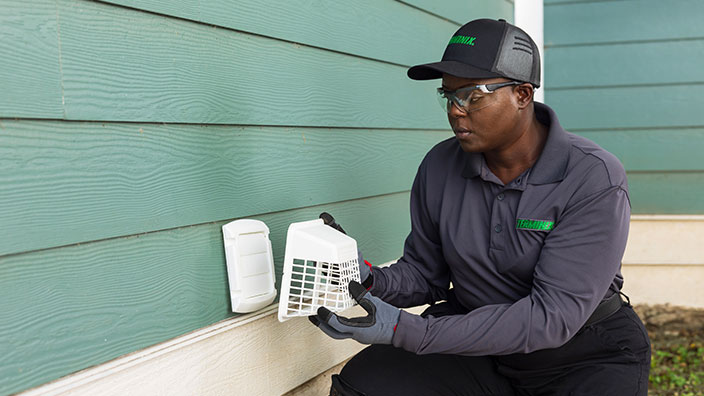
What are rats attracted to in your home that might encourage them to enter? Rats enter homes primarily in search of food, water, and shelter. They can squeeze through small gaps and holes, using their excellent climbing abilities to access entry points around roofs, vents, and garage doors. Once inside, rats can cause significant damage by gnawing on electrical wires, insulation, and structural materials. This could pose serious risks, such as fire hazards and structural weakening. Additionally, rats can contaminate food and surfaces with their droppings and urine, posing health risks to humans.

Do rats bite people? Are they dangerous?
Although they generally try to avoid people, rats can become aggressive and dangerous if cornered, attacking out of fear. While many rat bites are harmless, there is a chance the rat could infect a person with rat-bite fever or any number of pathogenic organisms. While rat-bite fever can be transmitted through a bite, a person can also become infected with this disease as a result of eating food or drinking water that has been contaminated by rats.
Signs of a rat infestation in your home
Seeing a rat in your yard does not necessarily mean you have rats in your home, but it can be a sign of a potential infestation. Other signs of a rat infestation in your home can include:
- Droppings: Small, dark, and cylindrical droppings, often found near food sources or nesting areas.
- Gnaw marks: Signs of chewing on wires, wood, or other materials, often seen around entry points or food storage areas.
- Nests: Shredded paper, fabric, or other materials used to build nests, typically found in hidden or undisturbed areas.
- Odors: A strong, musky smell from urine or nest materials.
- Visible rats: Spotting rats or their nests in attics, basements, or behind appliances.

How to help get rid of rats in your home
To help prevent rat infestations, consider the following tips:
- Seal entry points: Close gaps and cracks around your property, especially near pipes, vents, and your home’s foundation.
- Maintain cleanliness: Keep your home clean by promptly cleaning up food spills and crumbs. Store food in sealed containers and regularly dispose of garbage.
- Reduce clutter: Remove clutter and debris in and around your home where rats can find shelter or nesting materials.
- Consider professional help: If you suspect a problem or want a thorough inspection, consult a pest control professional for advice and treatment options.
Rats are among the 25 pests covered in our ongoing pest protection plan.1 Our PestFree365 plans help protect your home and family from many common household pests.2 A multipoint interior and exterior inspection can help identify where and how rats enter your home, and our regularly scheduled pest treatments help prevent them from returning. Schedule your inspection with Terminix today!
1Coverage includes: "House" Ants, Bird Mites, Indoor Ticks, Cockroaches, Carpet Beetles, Fabric Moths, Overwintering Insects, Ground Beetles, Centipedes, Crickets, Earwigs, Firebrats, Millipedes, Clover Mites, Pillbugs/Sowbugs, Psocids, Scorpions, Silverfish, Paper Wasps, Springtails, Spiders, Stored Product Beetles, Stored Product Moths, Mice, and Rats.
2Covered Pests defined in your Plan. Automatic payment sign up is required for PestFree365+. Voles and fire ants are only covered if they are in the home, we will not treat the lawn. Homes must be free of bed bugs at the initial service to qualify for coverage of bed bugs under the PestFree365+ Plan. Applies to single family, free-standing, owner-occupied homes only. Account must be in good standing. Other limitations may apply. See Plan for details.
Get started with rat control
![rodent control]()
Rodent control
- Free inspection identifies rodent intruders and their points of entry
- Custom treatment plan gets intrusive rodents out and keep them out
- Annual inspections ensure there is no new rodent activity for peace of mind
- If new rodent activity is found during our annual inspections, we will retreat to get them out and keep them out
- Be sure to ask your technician how to get $100 off rodent control