


Identifying and removing clover mites in the house
(Bryobia Praetiosa)
Clover mites (Bryobia praetiosa) are a species of mite from the Arachnida class. Entomologists estimate that there are anywhere from tens of thousands to millions of different types of mites all over the world, and clover mites make up just one tiny fraction of that.
Read on to learn more about these little red mites and how to deal with them.
Identifying clover mites
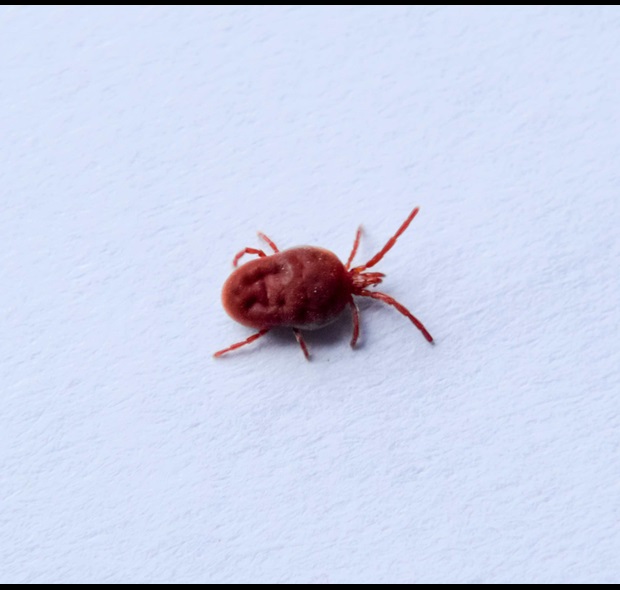
Clover mites are tiny, oval-shaped arachnids with eight legs. The two front legs are very long compared to the other six and are often confused for antennae. Adults are smaller than the head of a pin and rarely grow larger than 1/8th of an inch in length.
The larvae are bright red, while the older stages and adults are darker reddish-brown. They often gather on the sunny side of homes and buildings, and due to their small size, they are more easily spotted in groups. Clover mites can be mistaken for ticks sometimes, but there is no known species of red tick.
Chiggers vs. clover mites
Another microscopic red bug often confused with the clover mite is the chigger, also known as a berry bug or bush mite. Chiggers are even smaller than clover mites and usually can’t be seen with the naked eye. They also don’t have the same elongated legs as the clover mites.
While adult chiggers don’t bite humans, the larvae might. They feed on their host’s skin cells and can leave behind itchy red welts or bumps. Chigger infestations are usually located outdoors in yard debris, leaf litter, and woodpiles. They especially like shady areas.
The clover mite life cycle
Clover mites go through four life stages—egg, larvae, nymph, and adult. They are all females, so they reproduce via parthenogenesis, a form of asexual reproduction that allows embryos to grow directly from an egg without requiring fertilization of any kind.
Each clover mite lays about 70 eggs at a time that will overwinter and hatch in early spring. Over the summer, the mites go into warm-weather hibernation, and a new generation is produced in the fall.
What attracts clover mites?
During most of the year, clover mites are found outside on lawns and on other landscaping plants. They feed on plant fluids, such as grass, and are common outdoors around most buildings.
During the fall, the mites may deposit eggs within cracks of building foundations for overwintering.
In the spring, the tiny red larvae hatch and can make their way inside buildings through cracks around windows and in walls. Dozens, sometimes hundreds, of these mites can be spotted congregating on windowsills, curtains, and on walls.
Are clover mites dangerous?
Clover mites do not bite humans or pets, so they aren’t considered dangerous. They can, however, be harmful to plant life and property if their populations grow out of control. If crushed, they may leave a red stain that can be difficult to remove from fabrics.
Signs of a clover mite infestation
Clover mites can go unnoticed because of their small size, but they don’t usually last longer than a couple weeks inside because they won’t have access to their preferred food sources—grass, clovers, dandelions, ornamental flowers, and other vegetation. House plants and mold or algae may sustain them for a short period of time, but a large infestation is unlikely to grow.
A couple of signs of an infestation in a building may include:
Tiny moving spots of walls, drapes and window shades
Red stains on carpets, draperies, paper, or other light-colored surface
Getting rid of clover mites
The best method for getting rid of a minor infestation is vacuuming up the pests and cleaning the areas where they were found. Clover mite prevention can include:
Sealing up exterior cracks and holes where the adult mites might deposit their eggs.
Using dry material like crushed rock or pea gravel around the exterior of your home instead of mulch.
Keeping the foundation of your home free of moist plant matter like weeds and leaf piles.
Making sure weather stripping is in good condition and replaced whenever needed.
Calling a pest control expert like Terminix to assess your property and complete any clover mite control treatments as needed.