Beetles
Facts about beetles that you probably didn’t know
Discover fun trivia about beetles, some of the most prominent insects on Earth.
Content Updated: August 29, 2025
While they can certainly create headaches for homeowners, there are tons of facts about beetles that many would still find interesting. For instance, did you know that about 40 percent of all insects belong to the Coleoptera order, better known as beetles? That means that one-fourth of all animal species on this planet are beetles.
In fact, even if you threw plants into the mix, one in every five species of living organisms on Earth is a beetle. That’s a staggering number. Here are some more beetle facts that you may find astonishing.
Jump to section:
The ancient evolution of beetles
The ancient evolution of beetles
Beetles are part of the Coleoptera order, which is one of the largest orders in the animal kingdom. There are over 300,000 species of beetles identified, and still countless species out there waiting to be discovered—maybe as many as millions.
Not only are there thousands of types of beetles on the planet, but they’re spread out across the world, too. Beetles can live just about anywhere, even in freshwater bodies! The only exceptions are polar regions and the ocean. Who knows where scientists and entomologists will find them next?
Fossils of the first organisms to resemble beetles date back 270 million years, and the “true beetles” that roam the Earth today made their first appearance on the planet around 230 million years ago. This means beetles survived what killed the dinosaurs, all thanks to their incredible adaptive abilities.
The cultural significance of beetles
Not only are they as old as dinosaurs and even more hardy, but beetles also carry great significance in many cultures and traditions. From reverence to fear, beetles have symbolized things like fertility, good fortune, transformation, and more all over the world.
Most notably, in ancient Egypt, the scarab beetle was seen as a symbol of rebirth and regeneration, as a guide for individuals working towards spiritual awakening. They symbolized the cyclical nature of life and death, and they continue to be an iconic element of ancient Egypt’s symbols to this day.
Facts about beetle anatomy
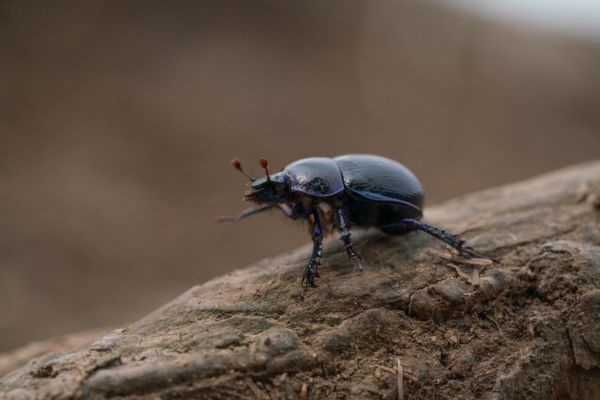
With how many species of beetles there are, there are just as many distinct anatomies associated with them. Here’s a rundown of all the unique things beetles can do.
Can beetles fly?
The short answer is yes; some beetles can fly! Now, here’s the long answer, and it involves an etymology lesson: the word Coleoptera comes from koleos and pteron—two Greek words meaning sheath and wing, respectively. Beetles are appropriately characterized by armored “sheathed wings” that protect the second, real pair of wings used for flight.
Although these sheathed wings are what their order is named after, not all beetles can fly. Many beetles that cannot fly, such as ground beetles and beetles that live in deserts or caves, have lost the ability to do so due to evolutionary adaptations, often from a change in anatomy that hinders their ability to use their wings, such as the fusion of their elytra (the protective wing-cases over their flight wings).
Can beetles swim?
Beetles that have undergone evolutionary adaptations to thrive in bodies of water—generally called water beetles—have unique anatomy that allows them to exploit their underwater surroundings. Of course, not all beetles can swim, but the ones that can boast some impressively distinct anatomy.
Some water beetles have fringed hind legs adapted for swimming, and many have well-armored bodies with modified wings. Certain water beetles carry an air bubble—referred to as the elytra cavity—that provides an air supply from under their abdomen, almost like a natural scuba tank, while others have a plastron, or “physical gill”, a patch of cuticle covered with hairs that can reliably retain a thin layer of air.
How do beetles eat?
All adult beetles chew their food thoroughly. In this sense, beetles are quite unique! Most insects use straw-like proboscises (tube-shaped mouthparts) to slurp their food up. Beetles can be an exception to this rule thanks to their special mandibulate mouthparts, which can be used to chew anything from plants to other insects, and even dead mammals. In fact, the word ‟beetle” is thought to come from bitela, which is Old English for little biter.
How strong are beetles?
Not only do many beetles exhibit fighting behaviors, such as stag beetles competing over mating rights, but many beetles are exceptionally strong. In particular, dung beetles are famous for being able to pull objects 1,141 times their weight. For comparison, that’s like an average adult human pulling four semi-trucks at once.
Beetles also have hard exoskeletons that protect them from damage and powerful mandibles and jaws that allow them to chew through all sorts of materials. Many beetles around the world are also served by their powerful leg muscles which support their digging and carrying. All this to say: beetles are some of the hardiest and strongest insects in the world!
Survival instincts
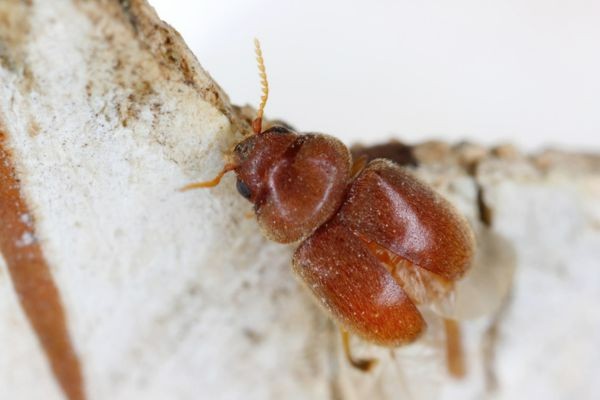
Beetles have all sorts of survival instincts that account for their ability to thrive in so many kinds of environments. Of course, having survived what wiped out the dinosaurs, it only makes sense. Here are some of the unique ways in which beetles survive:
- Diapause: Beetles can experience a period of dormancy that allows them to survive unfavorable environmental conditions. Diapause can occur at any life stage of a beetle, which further helps ensure survival.
- Water absorption: Certain beetles that live in dry environments can survive thanks to their ability to absorb water from the air through their rectums, and by reabsorbing water from their feces.
- Mimicry: There are two primary kinds of mimicry that beetles can exhibit, wasmannian and batesian.
- Wasmannian mimicry refers to when an animal resembles a different species to live among them. Ant nest beetles are a notable example—they mimic ants and live in their nests.
- Batesian mimicry is when an animal resembles a harmful species to avoid predation. One prominent example is the wasp beetle—a beetle that resembles a wasp and consequently evades predation.
- Chemical secretions: Some beetles, such as the blister beetle, secrete certain chemicals that deter predators. Others, such as the bombardier beetle, can eject a spray of chemicals as a defense mechanism.
- Camouflage: Some beetles can mimic the color and shape of their environments to avoid detection.
Standout beetle species facts
Every species of beetle is unique and brings something important to the ecosystems they occupy, from predation to scavenging, but there are still a few select ones out there that are truly something else!
- Whirligig beetle: These aquatic beetles have eyes that are divided into two pairs. One pair sees below the surface of the water while the other monitors above, with both sets keeping a “watchful eye” for prey and predators.
- Deathwatch beetle: If you hear a loud knocking noise coming from a log or fallen tree, it might be the deathwatch beetle, banging its head against the tunnels they’ve created.
- Tropical click beetle: A pair of oval organs on the thorax and one on the abdomen is what allows this particular species to produce light. Their eggs and larvae are luminous as well, glowing at night on the outer layers of termite mounds, helping to attract prey for food.
- American burying beetle: This beetle species allows for tiny mites to hitch rides on its back. The mites prevent fly eggs and microbes from gathering on the beetle or on the carrion meals that the burying beetle scavenges.
- Long-toed water beetle: This is an underwater beetle that never needs to resurface. Their plastrons, which give them a shimmering appearance
- Dung beetles: These beetles eat animal waste and play a critical role in the food chain. They speed up the recirculation of nutrients back into the soil or into other animals that eat them. The scarab—a type of dung beetle—was considered sacred in ancient Egypt!
Fun beetle trivia
To cap off our blitz through all sorts of interesting beetle trivia and info, here are just a few more fun facts:
- Did you know that humans eat over 300 species of beetles, mostly at the larval stage? Beetles are eaten by humans more than any other insect.
- Did you know that a tree planted in Los Angeles’s Griffith Park to commemorate the late, great Beatle, guitarist George Harrison, was overrun and destroyed by beetles? Bark beetles and ladybugs were the prime culprits.
- Did you know one of the fastest-running insects on Earth is a beetle? The Australian tiger beetle can run an average speed of 5.5 miles per hour! That’s the equivalent of running 171 body lengths in a single second.
As fun as these beetle facts are, if beetles are a problem in your home or garden, the only fact you really need to know about them is that one call to Terminix can help you get rid of them.