

What do earwigs (or “pincher bugs”) look like?
Part of the insect order Dermaptera, there are 2,000 species of earwigs found all over the world on every continent except Antarctica. They are mostly nocturnal and like to stay hidden in small, moist spaces during the day. They will emerge at night to feed on other insects and plants.
Find out more about how to identify earwigs, aka “pincher bugs”.
How to identify earwigs
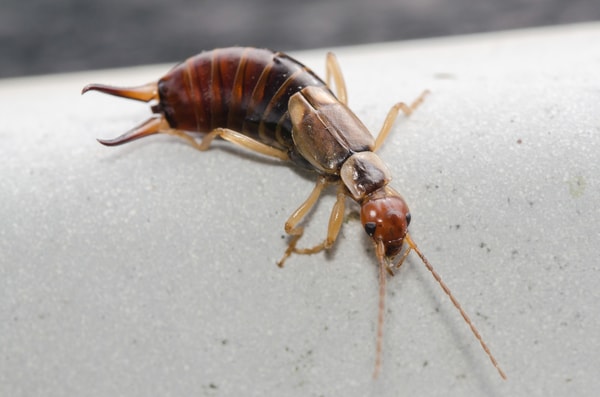
Earwigs are one of the most readily identifiable insects due to their cerci. Cerci are the two appendages that stick out from the rear of the earwig, resembling forceps or pincers. This has led to nicknames such as ‟pincer bugs” or ‟pincher bugs.” Though they can pinch, earwigs are rarely dangerous to humans unless they are sat on or trapped.
Instead, the cerci are used to fight off predators, grasp prey, and dominate other earwigs. Males have curved cerci, while females have straight pincers. Most species are reddish-brown in color and measure about three-quarters of an inch in length or smaller. They have a lifespan of approximately one year.
There’s actually not much more that you need to know in order to identify an earwig unless you want to study it. Entomologists study the segments of an earwig’s abdomen and antennae. This can help with species identification as well as distinguishing males from females. For example, males have 10 abdomen segments while females only have eight.
Some species of earwigs let off a foul-smelling odor when crushed. This is where the trained eye of a service technician comes in handy—if you know the species will defend itself using odors, earwig control might not include physically crushing them.
Common types of earwigs
While there are many types of earwigs, most homeowners and renters will only encounter a few of them. Here are the most common types:
European earwigs (Forficula auricularia): Also known as the common earwig and found all over the U.S. Around ½ an inch long with two sets of wings that they rarely use.
Ring-legged earwigs (Euborellia annulipes): Mostly found in the southern states and live primarily outdoors. They are recognizable by the dark circles that surround their yellow legs and their lack of wings and can grow up to 1 inch long.
Striped earwigs (Labidura riparia): Unique for the pair of stripes on the front part of their back. They are predators of other insects like millipedes and spiders and grow up to 1 inch long.
Maritime earwigs (Anisolabis maritima): Typically found around the coast with a blackish exterior, yellow underbelly, and large pincers.
Bugs that look like earwigs
Insects that are sometimes mistaken for earwigs include firebrats, silverfish, and rove beetles. Silverfish and firebrats have long, slender bodies with tail-like appendages that look like antennae. Silverfish have more of a shiny, pearl-gray color, and firebrats are grey with a mottled brown appearance, which sets them apart from common earwigs, which are brown, black, or reddish. Silverfish and firebrats are also nocturnal and prefer damp environments, just like earwigs. Rove beetles have a similar body shape and size to earwigs, but the main difference is that they don’t have the tell-tale earwig pincers.
Termites can sometimes be mistaken for earwigs as well due to their size and body shape. The difference in appearance is worker termites are lighter in color while earwigs are darker.
How to help get rid of these pests
Like most pests, earwigs usually enter homes in search of food and shelter. They will gravitate towards areas with water, like kitchens, bathrooms, laundry rooms, and cool, damp places like basements and crawlspaces. A noticeable increase in earwig activity can be a sign that there is excess moisture in your home.
To prevent earwigs, the first step is eliminating the places they like to hide in your yard like leaf piles, excess vegetation and stored wood. Any vegetation near your house like garden beds, trees and shrubs should be well maintained and have proper drainage. Next, clean out gutters and downspouts regularly. Seal any cracks and crevices in the foundation of your home and repair any doors or window frame gaps promptly. A dehumidifier in damp areas like the basement can help remove the excess moisture earwigs are attracted to.
Need help with earwig control? We can help with pest control strategies that are tailored to your needs.