

What to know about co-emerging cicada broods
Screaming cicada broods
Have you heard about the millions of periodical cicadas that will emerge this spring? If you live in the Midwest or Southern regions of the United States, you'll want to know what's going on.
The periodical cicadas we'll be discussing emerge every 13 and 17 years. This type of natural co-emergence hasn't occurred in 221 years and won't happen again until the year 2245. They’ll be hard to miss as scientists estimate there could be up to 1.5 million cicadas per acre coming out of the ground. You’ll start to notice them in the spring and early summer.
We spoke with Chad Gore, Ph.D., Entomologist and market technical director for Terminix, to learn more about when these cicada broods will emerge, where they’ll be emerging, and if there are any concerns associated with cicadas.

Where will cicada broods XIX and XIII emerge?
The 13-year group, known as Brood XIX or the Great Southern Brood, is the largest periodical cicada brood. The Northern Illinois Brood, or Brood XIII, emerges every 17 years. The two cicada broods emerge in Alabama, Arkansas, Georgia, Illinois, Indiana, Iowa, Kentucky, Louisiana, Michigan, Mississippi, Missouri, North Carolina, Oklahoma, South Carolina, Tennessee, Wisconsin, and Virginia.
When will the screaming begin?
You’ll start to notice them in the spring and continue into early summer. How long the cicadas will be present depends on the weather and location. Both massive broods will emerge in mid-May, ending in late June. With consistently warm and dry weather, the cicadas will finish mating faster, creating a shorter season.
Periodical cicada life cycle
The 13 and 17-year cicadas have two of the longest life cycles known for insects. Periodical cicadas spend most of their lives underground as nymphs. Underground, they feed off the sap of tree roots. Once they emerge they transform into adults and mate.
The “noise” you hear from cicadas is a mating call from the males attempting to court females. Romantic! Once cicadas mate, the female cicada makes slits in tree branches and lays eggs in the slit. The eggs hatch after two to six weeks. The nymphs fall to the ground and dig into the soil using their digging claws.
Nymphs are nearly fully grown in eight years, but they’ll continue to develop until the 13th or 17th year. Once the mature nymphs emerge from the soil, they find a tree, vegetation, or post to attach themselves to.
They attach themselves firmly to this surface because they need to molt (shed their outer shell) and transform into adults. When cicadas become adults, their outer shell (called the exoskeleton) splits along their backs. The adult cicada then gradually comes out through this opening. Once they're out, they only live for about four to six weeks.
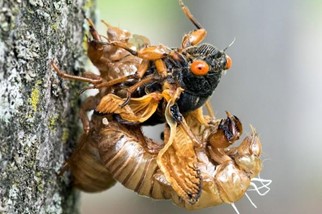
When cicadas molt and shed their old skin to become adults, they leave behind their old exoskeletons (referred to as exuvia), which are the hard outer coverings of their bodies. These exuviae are often found attached to trees and fences or scattered on the ground.
Annual cicadas vs Periodical cicadas
Periodical cicadas are insects with long life cycles (13 or 17 years), mass emergences, and loud choruses. There are seven total species of periodical cicadas. They have black bodies, red eyes, and orange wing veins. Periodical cicadas are one to two inches long and have a three to four-inch wingspan. The best way to differentiate cicada species is by their mating songs, which tend to be species-specific.

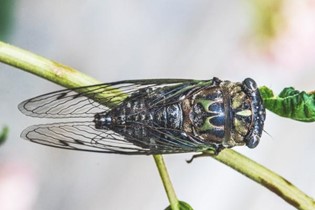
Annual cicadas do not have synchronized mass emergences and will emerge each summer. They tend to be larger than periodical cicadas and have black, green, or olive-patterned bodies with black or brown eyes.
Why do cicadas take so long to emerge?
After 13 or 17 years, these nymphs emerge simultaneously and in tremendous numbers. By coming to the surface in such large groups, many cicadas will survive because predators won’t have enough room in their stomachs to eat all of them at once.
Additionally, staying underground for so many years allows them to avoid predators. Highly specialized predators regulate insect populations, for example, the cicada killer wasp. Emerging every 17 years makes it difficult for predators to rely on 17-year cicadas as a steady food source because they're so rare and unpredictable for predators to find.
Are cicadas dangerous?
Cicadas do not bite or sting and are not dangerous to humans or pets. The 13-year and 17-year cicadas also cannot transmit disease. Adult cicadas do not feed, so they will not damage foliage. However, female cicadas can cause damage to young trees due to the cuts they create while laying eggs. Most trees will be fine and can easily be protected with netting.
Does Terminix treat cicadas?
There is no need to treat cicadas with pesticides. Treatment is usually unnecessary since cicadas’ lives are short-lived. They’ll naturally go away in about five to six weeks.
Don't worry if you don’t like bugs; they won’t be around long. If you do like bugs, get out there and enjoy this once-in-a-lifetime moment! After all, it won’t occur again for another 221 years.