Education
Centipedes vs. silverfish: What's the difference?
Content Updated: January 27, 2026
Key takeaways
- Centipedes and silverfish are commonly confused household pests, but they belong to different classes and have distinct characteristics.
- House centipedes can grow larger than silverfish, typically reaching up to an inch and a half in length, while silverfish average between half an inch to one inch.
- Both pests thrive in moist environments, but silverfish primarily feed on starchy materials, making them a potential threat to paper and clothing.
- While silverfish can cause damage to household items, house centipedes can play a beneficial role by preying on other pests, such as spiders and cockroaches.
Jump to section:
- Identifying centipedes vs. silverfish
- Centipedes vs. silverfish in homes
- The dangers of silverfish and centipedes
- Silverfish and centipede prevention and control
Silverfish and house centipedes can be alarming sights, even if you are familiar with them. Both have an appearance that can be described as “creepy” and can be quite a household nuisance. While there are quite a few differences between the two, sometimes people may confuse these pests. Keep reading to find out more about the centipede vs. silverfish.
Identifying centipedes vs. silverfish
Centipedes are part of the Chilopoda class and are not actually insects. Centipedes can have many body segments, so depending on the species, they can have up to 177 pairs of legs (with the average being around 35). While that is definitely a lot of legs, it’s not quite as many as the millipede, which has two pairs of legs per body segment. Despite common belief, centipedes do not have 1,000 legs but can have up to around 750. Most centipedes have a pair of modified claws behind their head that can be venomous.
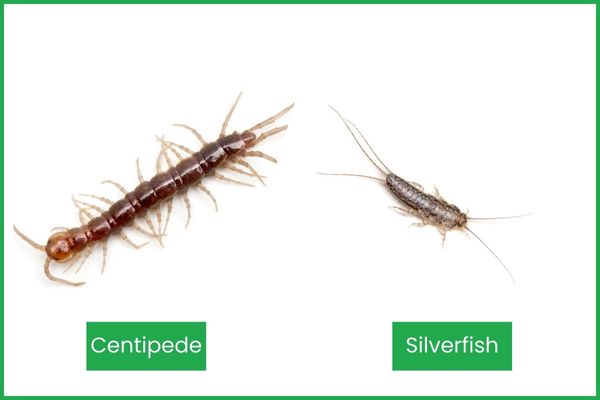
Besides where they live indoors, another similarity between house centipedes and silverfish is that both can be very quick movers. Though silverfish and centipedes may occupy some of the same areas indoors, there are quite a few differences between the two. For one, the silverfish is an insect unlike the centipede, and has the traditional 6 legs. When it comes to centipedes vs. silverfish, here are some other physical differences:
- Silverfish won’t grow quite as long as house centipedes, with an average length of half an inch to one inch. House centipedes, on the other hand, can grow to be about an inch and a half in length.
- Silverfish are shiny gray or silver, while house centipedes are grayish-yellow.
- Silverfish are uniform in color throughout their body, while house centipedes have dark longitudinal stripes, as well as bands on their legs.
- Many species of centipedes are venomous, while silverfish are not.
Centipedes vs. silverfish in homes
House centipedes and silverfish are two common pests that often inhabit homes, as they are attracted to the moist indoor environments that provide food and shelter. House centipedes are easily recognizable by their long, spindly legs and their ability to move quickly. Indoors, they prefer dark and moist areas of the house, such as basements, damp closets, and bathrooms. While you might think that the house centipede only lives indoors, based on its name, it can also be found outdoors.
Silverfish, on the other hand, thrive in similar environments due to their diet, which consists mainly of fungal molds and organic materials. They prefer areas that offer starchy substances for feeding, such as wallpaper and book bindings, making attics and crawl spaces ideal locations to find them. Both centipedes and silverfish inadvertently enter homes through cracks, crevices, or other small entry points, particularly when outdoor conditions become unfavorable. Interestingly, house centipedes are actually predators of silverfish, and their presence can help control silverfish populations.

The dangers of silverfish and centipedes
Silverfish and centipedes are often regarded as pests in homes due to their unsettling appearance and potential to cause damage. Silverfish can be harmful as they feed on starchy materials, such as paper and clothing, potentially damaging important documents and fabrics. Centipedes, on the other hand, are predatory and can help control other household pests, such as spiders and cockroaches, making them somewhat beneficial. Neither of these insects is aggressive towards humans; silverfish tend to stay hidden and avoid light, while centipedes may bite if provoked, but this is rare and usually results in only minor irritation.

Silverfish and centipede prevention and control
No one wants pests like silverfish and centipedes in their home. Here are a few centipede and silverfish prevention tips to keep them out of your space.
- Seal any cracks and crevices in your home
- Ensure proper ventilation
- Reduce humidity to create an undesirable environment
- Regularly declutter your space and keep it clean
Unfortunately, these pests can be challenging to eliminate. Whether you’re dealing with pesky silverfish or creepy house centipedes, Terminix can help. Learn more about our expert centipede control and silverfish control.