Education
Carpenter ant queens
Content updated: May 15th, 2026
Key takeaways
- Carpenter ants are large, wood-excavating pests that can cause significant structural damage to homes if left unchecked.
- Identifying the carpenter ant queen is crucial for effective control, as she is the primary reproductive in the colony.
- Carpenter ant colonies consist of parent nests containing queens and eggs, as well as satellite nests that host larger larvae and pupae.
- Preventing carpenter ant infestations involves proactive measures such as eliminating moisture sources, trimming tree limbs, and storing firewood away from the home.
Jump to section:
What do carpenter ants look like?
How to identify the carpenter ant queen
Carpenter ant queens and their colonies
How to get rid of carpenter ant queens
Carpenter ants are common invaders in homes across the United States. These ants excavate wood as they tunnel and build their nests. While they most frequently nest outdoors, they can be found on roofs and in woodwork near sources of moisture, causing structural damage to homes.
Like other species of ants, carpenter ants have a sophisticated social structure and caste system. The head of the colony is the queen, and successfully treating a carpenter ant infestation typically requires eliminating the queen to halt reproduction. Find out what a carpenter ant queen looks like and learn how you can help prevent infestations with professional ant control.
What do carpenter ants look like?
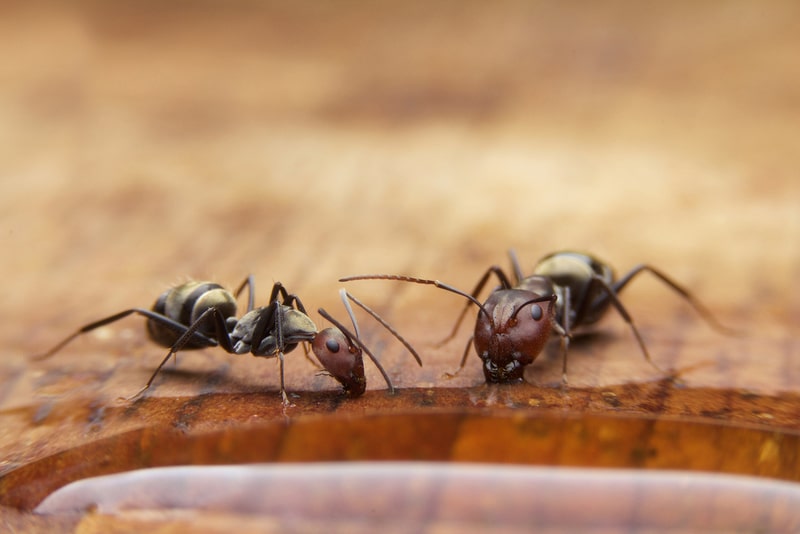
Carpenter ants are among the largest ant species in North America, measuring between one-eighth and five-eighths of an inch in length, depending on their species and role in the colony. Worker ants can be classified as “major” or “minor” based on their size and function. These ants can be various colors, including red, brown, black, and yellow. Carpenter ants are distinguished by their constricted waist, bent antennae, and a single node between their thorax and abdomen.

How to identify the carpenter ant queen
First, it’s important to note that it’s extremely rare for most people to encounter a big black ant queen, specifically a carpenter ant queen. That’s because it’s the job of the colony to protect the queen, keeping her hidden within the confines of a wood nest.
Carpenter ant queens are often darker, typically black or dark brown. They are much larger than other ants in the colony and can measure up to an inch in length. If the queen is ready to lay eggs, she can be easier to identify because she will be the largest ant in the colony. However, a single carpenter ant colony can contain multiple queens, which can make it even more difficult to identify the queen.

Carpenter ant queens and their colonies
Carpenter ants are notorious for their nesting habits and social structure, making them difficult to control. They form two types of nests:
- Parent nests, which contain the queen, eggs, and small larvae, are typically located in damp or decaying wood near moisture sources
- Satellite nests, which house larger larvae and pupae, can be found in drier areas like hollow doors and attic insulation
The carpenter ant queen plays a crucial role in the colony. When females reach reproductive maturity, they swarm with winged males in spring and summer. After mating, males die, and the queen sheds her wings to establish a new nest. She begins her life cycle by feeding her initial brood of 15-20 eggs using stored fat. These first workers then take over foraging and caring for the young, allowing the queen to focus solely on egg-laying.
If the queen dies, the colony's reproductive capacity is severely reduced, as she is the primary source of new ants. Without her, the colony may gradually decline as worker ants age and die off, leading to eventual collapse.
How to get rid of carpenter ant queens
When it comes to preventing ants, many homeowners often resort to DIY methods. However, squashing or killing carpenter ants on your own can actually make an infestation worse. This is because the release of pheromones upon death signals other ants from the colony to investigate the area. Plus, if the ants feel threatened, they may bite. Their bites are not venomous, but they can certainly be painful.
To effectively limit carpenter ant activity and prevent infestations, here are several proactive steps you can take around your home:
- Store firewood away from your home and ensure that any dead wood or tree limbs are away from the foundation.
- Trim dead limbs from trees and remove stumps, as these serve as potential nesting sites.
- Repair plumbing, leaky gutters, wood rot, and roof leaks.
- Check crawl spaces for excess moisture.
- Ensure water from rain gutters flows away from your house.
Effective carpenter ant control involves not only targeting satellite colonies but also eliminating the queen and the parent colony. Getting rid of the carpenter ant queen can be difficult, and enlisting a professional is highly recommended. Terminix pest control technicians can help identify and eliminate carpenter ant populations on your property, providing homeowners with peace of mind.