Commercial
Resolve Fly Problems with Lumnia
Fly problems in your business are more than an annoyance – they are a public health hazard that can disrupt your operation and your bottom line. While flies are active year-round, more businesses are likely to encounter fly problems in the summer as temperatures, odors, and conditions are ideal for flies to thrive.
Having fly control measures in place is a great way to proactively protect your business from fly activity. With many businesses focused on environmental responsibility, identifying a fly control solution that can not only protect your business but also contribute to your sustainability goals is a winning formula. Lumnia, an LED-powered insect light trap from Terminix, does just that by offering energy savings and a non-chemical alternative to eliminate flying insects.
Flies: A Prevalent Pest
Flies are one of the most persistent pest problems for businesses. From food processing plants to hospitals to restaurants and hotels, flies can plague nearly any environment. That's no surprise given their prevalence around the globe. Scientists estimate that there are between 110,000 and 120,000 species of flies in the world, with nearly 18,000 of them found in North America.
Flies can reproduce quickly and in large numbers, which makes them a very successful pest. Some species can go from egg to adult in a week's time under the right conditions. With an adequate food supply, the average housefly can live for over 50 days. All of this means that a fly problem can develop quickly and be difficult to eliminate if left unaddressed for even a short period of time.
Insect light traps are excellent tools for combating flying insect issues, however, technology has come a long way. Be sure your organization is investing in the most advanced insect light trap technology.
Lighting the Way in Fly Control
Insect light traps have long been central to controlling fly populations in commercial environments. However, they came with a number of inherent issues: high energy usage, noise, blowout of pest fragments upon impact, messy glueboard changes, and relatively functional design that isn't ideal for many front-of-house environments.
After years of research and testing, Lumnia was developed as a proprietary insect light trap to solve many of these problems. Through the use of high-attraction LED lamps, Lumnia has been proven to catch flies up to 46% faster than other major insect light traps available today.5 LED lamps are also more sustainable because they use less energy and are a safer alternative, especially when it comes to discarding the lamps since fluorescent bulbs contain mercury.2
In addition, Lumnia has been designed to attract, kill, and encapsulate flies sustainable and hygienically, helping to eliminate the risk of contamination from flying insects and fragmentation of caught insects.
In the United States, Lumnia is available in four models: Standard, Slim, Compact, and Ultimate making it a versatile option for a wide range of business environments.
Lumnia Range: Model-by-Model Benefits
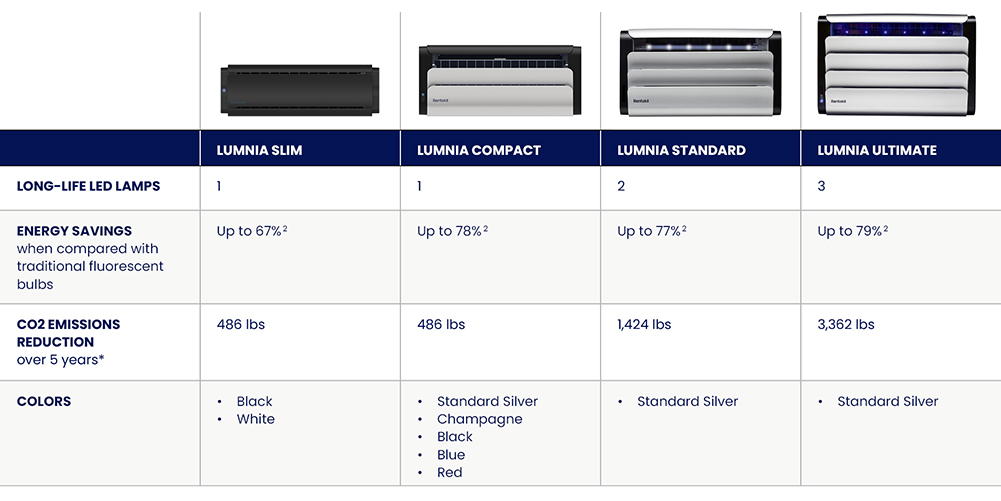
Lumnia's four models each offer unique benefits to your business. Use this comparison chart to see what model could be right for your business.
Other benefits from our world-leading Lumnia ILT range include:
Catches over 15 different flying insects such as house flies, fruit flies, drain flies, and more
Up to 46% faster at catching flies, on average, than competitor LED insect light traps on the market – leading efficacy and performance compared to other available competitor LED solutions on the market5
Encapsulation module – unique technology gives our customers highly effective hygiene control by using an adhesive film inside an encapsulation cassette to trap, collect, and contain insects eliminating the risk of secondary infestations from debris.
The open/close feature makes units easy to service, so there’s minimal disruption to your business
Zero mercury – Lumnia won’t be affected by the upcoming fluorescent tube ban.
Greater area coverage than any comparable insect light trap – with Lumnia, your customers can benefit from an expansive area coverage of up to 2,690 sq ft.4
Diseases That Flies Spread
Flies are widely known as prominent vectors of disease and pestilence. Because of the environments where they breed – garbage, dead animal carcasses, human and animal waste, to name just a few – they can pick up, harbor, and can potentially transfer an incredible number of pathogens and organisms, including those that can cause severe illness and even death in humans.
House flies are known to carry and spread organisms that can be responsible for human illnesses such as Salmonellosis, cholera, tuberculosis, and Typhoid. They can also carry and transfer E. coli and anthrax. Their biological construction, feces, and feeding behavior make them efficient vehicles for these pathogens
Lumnia is designed to capture flies safely and effectively, encapsulating them to further eliminate the potential for disease spread.
Pest Control and Sustainability
Many business operators are faced with what may seem to be the competing challenges of achieving maximum efficiency while remaining environmentally responsible or sustainable. This may seem like an especially tough dilemma when it comes to pest management. However, nothing could be further from the truth.
Pest management and control methods have seen incredible advancements in the last two decades, steadily marching toward a less chemical-reliant approach. The concept of integrated pest management is built on the idea of using non-chemical tactics, environmental modification, monitoring, and mechanical controls to prevent pest infestations, using targeted product applications only when necessary.
Today, forward-thinking pest management companies like Terminix are utilizing innovative technology to help further reduce the use of pesticides. In the area of fly control, technology has been especially powerful and led to the development of our proprietary, more sustainable and energy-efficient insect light trap line, Lumnia.
The Growing Importance of Sustainability
As climate awareness becomes more prevalent, more consumers are making choices on how to live, where to work, and what to buy with a sustainability mindset. In a January 2023 report, Nielsen IQ asked consumers what role sustainability was playing in making lifestyle decisions. One-third said that sustainability was an important part of their lives that they try to activate daily, while another 48 percent said that it was important for society that they make a sustainable choice whenever possible.
Climate and sustainability are pressing issues for younger generations. In its 2023 Gen Z and Millennial Survey, global consulting firm Deloitte found that among Millennials, climate change is second to only cost of living among top concerns, with 23 percent of those surveyed citing it as a top concern. For Gen Z, that number dips only slightly to 21 percent. In the survey results, some respondents cite instances where they have refused work projects because it did not align with their sustainability beliefs.
Having a more sustainable pest management program can not only improve environmental quality and protect the integrity of products, but it also boosts employee sentiment about the actions being taken by their employer on behalf of the environment.
4 Reasons to Choose the Lumnia Range
If your business is looking to reduce energy costs or increase its sustainability initiatives, Lumnia is an excellent fly control solution – in fact, it was honored in 2020 with the Queen's Enterprise Award for Innovation, presented on behalf of the United Kingdom government in recognition of commercial products that successfully leverage unique innovation. Here are four specific reasons why Lumnia could be the right solution for your business.
- Increased energy savings - Lumnia LED lamps save up to 79% energy compared to fluorescent bulb ILTs when using their unique adaptive mode technology2. Lumnia Compact, Standard, and Ultimate all feature adaptive mode options where you can opt to increase or decrease the power output of the lamps without significantly compromising the efficacy of the unit.
- No toxic chemicals - Lumnia LED lamps do not use any mercury, creating a safer environment for your business and for our Technicians.
- Up to 75% reduction in lamp waste - Lumnia LED lamps need to be replaced less frequently than traditional fluorescent bulbs. Often, Lumnia bulbs can last up to four years, quadrupling the life of fluorescent bulbs, which often have to be replaced annually1. This means that for every four fluorescent bulbs, you only need one Lumnia LED lamp, thereby reducing your lamp waste by 75%. This also means fewer lamps going to landfills, reducing overall waste substantially across our broad customer base around the globe.
- Reduction in carbon emissions - Lumnia can help businesses be sustainable with a 62% reduction in carbon emissions vs. prior models. Over just six years, based on data from the Environmental Protection Agency Greenhouse Gas Equivalencies Calculator, Lumnia has saved 53,139 tons of CO2 – that’s equivalent to powering over 6,072 homes for a year6.
Innovative, Trusted Pest Solutions from Terminix
As the global leader in pest management solutions for commercial environments, Terminix is powered by our local service around the globe. One of our local experts would be happy to provide you with a FREE fly control consultation and show you how Lumnia can benefit your operation.
Learn more about our innovative, trusted pest management solutions for businesses or call 1.877.TERMINIX today to speak to a representative.
1 4-year lamp life based on manufacturer testing of Lumnia LED lamps; lifespan percentage based on available competitor claims as of October 2023.
2 Findings based on comparison study conducted by Rentokil Initial in 2019 between Lumnia models (on Low Power Mode setting) and various fluorescent bulb insect light traps.
3 Findings based on calculations of Lumnia Compact vs average competitor units using traditional fluorescent tubes over a 5-year period based on product life cycle using the U.S. Environmental Protection Agency’s Greenhouse Gas Equivalencies Calculator.
4 Findings based on study conducted by Rentokil Initial in 2023 comparing max coverage area using Lumnia Standard model in a dark room versus the claimed max coverage area of competitor fluorescent bulb insect light trap units.
5 Findings based on a controlled laboratory catch rate study conducted by Rentokil Initial in 2023 using the Lumnia Standard versus 5 competitor models.
6 Findings based on Lumnia range kilowatt-hour usage since launch vs. kilowatt-hour usage of 135 competitor ILTs in the last 3-4 years.