Bug Facts
Why Are Bugs Attracted To Light?
Light is like a magnet for some bugs. Find out why.
Ever notice that artificial lights tend to either attract or repel bugs? That’s due to phototaxis, the process in which an organism alters its movement in response to light. While it’s still unclear why some bugs love the spotlight, and others hate it, there are a few theories that may offer a little insight. Read on to learn more about phototaxis, how it impacts bug behavior, and how light factors into pest control.
Understanding phototaxis
Phototaxis is how an organism responds to light with motion. Think about how you may have to rotate houseplants as they grow towards the window. That's an example of phototaxis. Many insects and bugs respond to light, as well. Bugs that move toward the light, like moths, are positively phototactic, while bugs that run away from the light, such as cockroaches, are negatively phototactic. Other common insects like fleas, termite swarmers, mosquitoes, and flies have their own unique reactions to light. Knowing how phototaxis applies to certain pests can help you manage and prevent infestations around your home.
Theories for why bugs are attracted to light
We don’t know exactly why bugs are attracted to light, but there are plenty of theories that might tell at least some of the story. Here are some of the top theories on which bugs are attracted to light and why.
Navigation by moonlight
Some flying insects, like monarch butterflies and many types of moths, are migratory. They use the moon and stars to guide their internal navigation systems. One enduring theory is that insects are mistaking artificial lights for their usual navigation source—the moon. Research published in Nature Communications has offered a slightly different perspective to explain this phenomenon. A study showed that insects aren’t necessarily attracted to the light but are disoriented by it. Their erratic flight patterns around artificial lights are due to the “dorsal light response,” where insects are compelled to turn their backs to the light. In nature, most light comes down from the sky, so insects are able to stay properly oriented, but with artificial lights, they get confused and fly in circles. The theory is difficult to prove because studying insect flight patterns can be challenging, especially in the dark.
Light & heat attraction
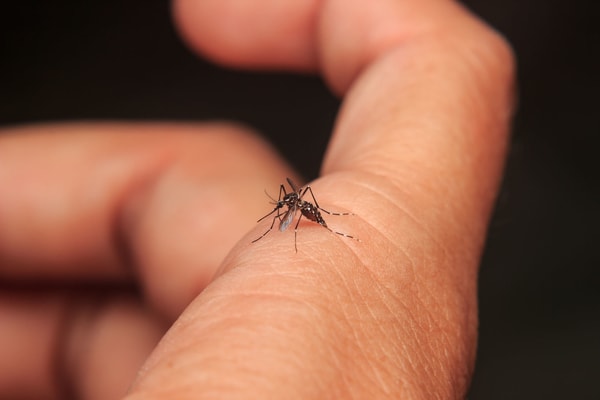
We know that insects are much more active during the warmer seasons. With that in mind, the theory is that bugs may be attracted to light sources because of the heat they emit. This theory doesn’t apply to every type of insect, but mosquitos, in particular, are known to be attracted to heat. LED lights emit very little heat, so in theory, they won’t attract bugs the same way incandescent lightbulbs do.
Mistaking light for open spaces
The “open-space response” refers to insects being attracted to bright gaps and away from dim, closed spaces. Open spaces make flying easier, so if an insect detects light, it might head in that direction instinctively. This theory applies to most flying insects like flies, termite swarmers, fleas, and more, but is little more than a theory due to the challenge of testing the hypothesis reliably.
Predatory & mating signals
Another idea put forth is that male moths think artificial light sources are potential mates. Apparently, female moths attract males with pheromones that just barely emit light. So, some have conjectured that male moths might be attracted to candle flames because they think they're about to meet a female who's ready to mate. Male fireflies are also known to flash light to attract females as the first stage of courtship.
How light affects insect behavior
Insects act on instincts. While light can play a role in their usual activities, it can also throw them off. Flying erratically around light can be due to disorientation and eventually exhaustion after spending too long trying to orient themselves. Spending time in the light can also make insects targets for larger predators like birds and bats.
If you’re wondering which bugs are attracted to light, the answer is most flying insects, including mosquitos, flies, fleas, moths, flying beetles, swarming termites, and more.
Keep bugs in the dark
Getting rid of bugs that seem to show up for light can sometimes just be a matter of turning off the light. But that’s not always practical. Instead, make sure your home is secure so bugs aren’t finding a way inside. Avoiding certain types of lightbulbs in outdoor areas might help reduce swarms of bugs. Bright light and bluish (mercury vapor, white incandescent, and white fluorescent) seem to be the most attractive. Yellow (sodium vapor), pinkish, and orange lights seem to be less attractive.
Need help with insects that are attracted to light? We can help with pest control strategies that are tailored to your needs.