

How to get rid of flying ants
Insects that fly can be frightening, but ants that fly might seem even scarier. Ants are typically seen crawling on the ground, so it's shocking when ants with wings start buzzing around in the air. Winged ants become even more imposing when they swarm during mating periods, gathering at specific land structures in a behavior called ‟hilltopping." These swarms are an impressive sight to behold, but how do we get rid of them?
Can ants fly?
Flying ants aren't some kind of genetic mutation. Ants that fly or have wings are called "alates" and are sexually mature ants. They are "alternate reproductives" created by the queen and fed by the worker ants in a colony. The reproductives go through their immature stages while developing inside the colony. When the ant colony is naturally ready to expand, the winged ants are ready to take the stage and establish a colony of their own.
All type of ants have complex societies and ways of interacting with one another. Learning about these interactions and habits can help you better understand these creatures:
- They are social insects that live in colonies and can be found in the ground, in trees, and sometimes developing in man-made structures.
- Once they mate, queen ants shed their wings and spend the rest of their lives inside their colonies. Male winged ants die after mating.
- Queen ants can live for several years and lay thousands of eggs a year. When the eggs mature, most become wingless female worker ants forage for food, protecting the colony, and caring for the queen's offspring.
- When the ant colony is large enough, certain young ants are fed special food by worker ants and are able to mature sexually and grow wings.
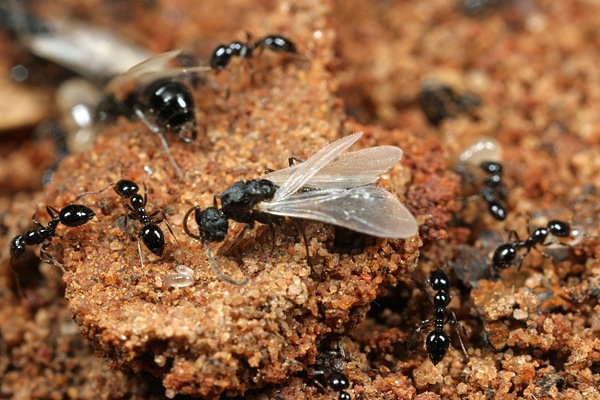
What do flying ants look like?
Flying ants unlike termites have some distinct features that can help you tell them apart from another pest. Carpenter ants with wings can be identified by their wing length, antennae shape, and waist size. They have large forewings and small hind wings. Their antennae are bent, and their waist is narrow.
Like clockwork, new colonies will develop around the same time each year depending on the ant species and where in the country they are located. This behavior ensures ants of the same species have better genetic diversity between colonies It initiates when certain conditions exist to trigger the winged ants to leave their home and start their mating flight. These environmental conditions include low winds, high humidity, and warm temperatures, preferably after three to five days of rain. These conditions happen most often in the late spring and early summer. However, different species of ants swarm at different times of the year, and many species swarm at night.
Are flying ants dangerous?
Huge swarms can be intimidating, but the ants have only one thing on their minds: mating. Flying ants in the house are no greater danger than your typical ant that crawls.
If a species of ant doesn't sting or bite, the alates of that species won't bite or sting either. If the ant species has the ability to pinch/bite with its mandibles, like a carpenter ant, it can still pinch if handled. If the ant species is known for stinging, like fire ants, the winged version can still do the same. It's highly unlikely that ants will bite or sting you while flying.
What causes flying ants in your house?
There are two reasons you have flying ants in your house. If you see a few ants, they probably flew in through a door or window, looking for a swarm. These ants will likely die before they can mate and set up a colony. Simply vacuum them up, dispose of the bag, and close up any gaps in screens or windows that would allow other flying ants inside.
If you find a large swarm of flying ants in your home, you may already have a colony in your walls or under the foundation. Removing the ant swarm isn't enough. You must locate the colony and then use an appropriate treatment to destroy it.
Flying Ant Control
Flying ants can be tricky to spot and even harder to treat. Enlist the help of your local Terminix technician to effectively remove these insects from your property. When you work with us, satisfaction is guaranteed. Learn more about our ant control treatment plans today.